Shivers, 87 minutes, Rated R, David Cronenberg, Canada, 1975
PRESENTED BY THE CANADIAN CULT REVUE | RESTORED DIGITAL PRINT
Cronenberg's first commercial film, about genetically-engineered parasites turning the residents of a luxury high-rise into sex maniacs, shows the shape of things to come in his career; it “scares and shocks us because it's so cleverly made." (Roger Ebert)
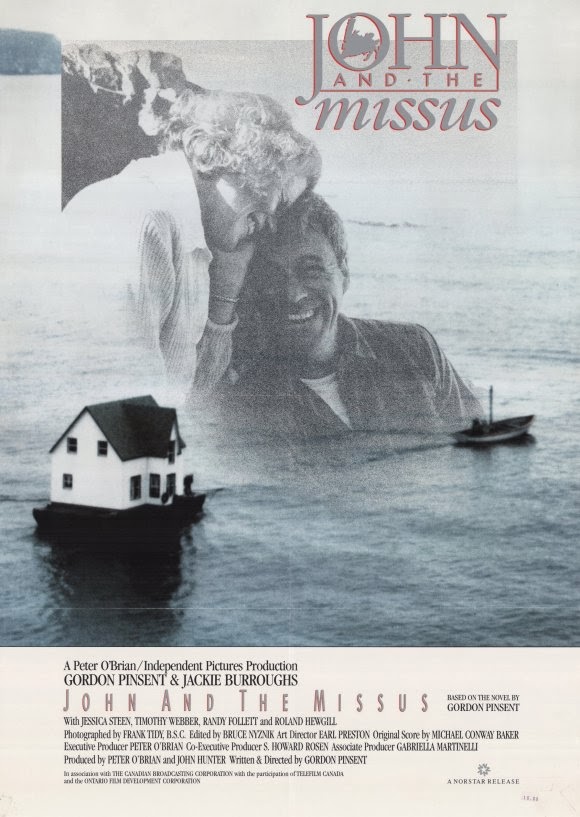
John and the Missus, 1987, 35mm Archival print, 95mins,Mayfair Theatre, Jan. 28th 9pm
John and the Missus is the story of one man’s passionate attempt to fight for the land he loves and the way of life he believes in. Set against the rugged beauty of Newfoundland’s coastal landscape, this romantic drama unfolds during the early sixties when the future of an isolated mining community is threatened by the government’s planned resettlement program.
When a cave-in at the Cup Cove copper mine gives a government representative the opportunity to permanently close the mine – and, by extension, the town – John (Gordon Pinsent) fights back to save the mine and the town he loves. This struggle tests not only the deep love that John and the Missus (Jackie Burroughs) have for each other and their family, but John’s own sense of self. When resistance proves futile and everyone around him has given in, he literally uproots his house and sails away.
John and the Missus was clearly a labour of love for Gordon Pinsent, who directed and stars in the film and adapted the screenplay from his own novel. In many ways, it is a companion piece to Peter Carter’s The Rowdyman (1972). Also written by and starring Pinsent, The Rowdyman focuses on a young rabble-rouser who stirs up trouble in his Newfoundland village, while John and the Missus depicts the importance and sanctity of community to a more mature and wiser man. A sentimental look back to a time when small Newfoundland communities were a way of life to be treasured, the film was nominated for six Genie Awards and won for Leading Actor (Pinsent) and Music Score (Michael Conway-Baker).
The Silent
Partner, 1979, Directed by Daryl Duke, 106mins, 1.85, mono,
rated R, 35mm original print, Mayfair Theatre Dec. 10th 9:15pm
Christopher Plummer gets to play big, bad, and bold as
the villain of The Silent Partner, a thriller set in late 1970's Toronto. Using the Eaton
Centre as a prime location, The Silent Partner also stars Elliot Gould as a bank clerk out to thwart
Plummer's plans. Great fun, and more than a little shocking at times for its
ferocious depiction of ruthless criminality. This film was written by Curtis
Hanson, who later went on to direct L.A. Confidential, The River Wild,Wonder Boys and 8 Mile. A highlight of the Tax Shelter Years, this film was one
of the more polished films of the era. Also starring Susannah Yorke. Watch for
an appearance by John Candy.
Screening at theMayfair Theatre, November 26th, 9pm Archival 35mm print from 2003, fully restored by the Motion Picture Lab of Library and Archives Canada
Year: 1931
Language: English
Format: 35mm Black & White
Runtime: 71 min
Director:George Melford, Varick Frissell
Producer:Varick Frissell, Roy Gates
Writer:Varick Frissell, Garnett Weston
Cinematographer:Maurice Kellerman, Alfred Gandolfi
Editor:Alfred Gandolfi
Sound:Alfred Manche
Cast:Charles Starrett, Louise Huntington, Arthur Vinton, Bob Bartlett
Production Company:Newfoundland-Labrador Film Company
Two Newfoundlanders – good guy Luke Oarum (Charles Starrett) and bully Jed Nelson (Arthur Vinton) – compete for the love of Mary Jo (Louise Huntington). Not wanting to leave Luke alone with Mary Jo, Jed ensures that his rival comes seal hunting with him on a ship skippered by Captain Barker (Bob Bartlett), even though Luke has a reputation as a “jinker” – someone who brings bad luck to his shipmates.
After several misadventures on board ship – for which Jed always makes Luke appear responsible – the two become isolated on the ice during the hunt. Jed attempts to kill Luke, but when a fierce storm cuts them off from the ship and Jed becomes snowblind, Luke leads him back to land by crossing the ice-floes on foot. They arrive back in town just as a memorial service for them is being held. Jed tells how Luke saved his life and Luke wins the hand of Mary Jo.
This extraordinary portrait of the Newfoundland people’s “dramatic struggle for existence” was produced by the Delaware-incorporated Newfoundland-Labrador Film Company, headed by twenty-eight-year-old Yale graduate Varick Frissell, an explorer and documentary filmmaker who by the age of twenty-three had already explored the interior of Labrador by canoe. The role of the ship’s captain was played by legendary Capt. Bob Abram Bartlett, the Newfoundlander who had captained Robert Peary’s 1908-09 expedition to the North Pole.
Not only was The Viking one of the first talkies, it was also the first location shoot outside Hollywood financed by Paramount Studios and, most notably, the first film to record sound and dialogue on location – on the ice-floes themselves, no less. Though Frissell shot all the extensive actuality scenes involving life aboard ship and the seal hunt, Paramount insisted that Hollywood director George Melford (Dracula) direct the fiction scenes. When test screenings confirmed Frissell’s concern that the overt melodrama of these sequences conflicted with and detracted from the power of the actuality content, he returned to Newfoundland to shoot more footage that would replace many of the clunky romantic scenes. He set sail on the Viking in March 1931, but six days later the ship exploded, killing twenty-seven men including Frissell and all but one of his crew. The cause of the explosion was never determined and Frissell’s body was never found – despite a handsome reward offered by his wealthy family.
The film was released in its initial form, including the awkwardly staged love scenes that do indeed detract from the authentic portrait that Frissell had wanted. To capitalize on the publicity, the film’s title was changed from White Thunder to The Viking and was advertised as “the picture that cost the lives of the producers, Varick Frissel, and twenty-five members of the crew.” It enjoyed a good deal of success in the early thirties, then faded into obscurity.
Though The Viking is technically not a Canadian film, its particular mix of dramatic fiction with footage of the wild, hostile and foreboding landscape imbues it with an especially Canadian spirit and style that distinguishes it from many of the legally Canadian “quota quickies” of the same era. It has much in common with the work of Robert Flaherty and is comparable to the contemporaneous The Silent Enemy in that the environment becomes a principal character in the drama.
"As a child, I used to think home
movies, compared to proper films, inept and boring. But I've been
converted--many examples I've seen have been beautifully shot and historically
invaluable. See for yourself at your local Home Movie Day event in October."
--
Kevin Brownlow
"Home Movie Day is the perfect
opportunity for people to connect with our past and to move the conversation
about preserving our cultural heritage into the future."
--
Ken Burns
"Saving our film heritage should
not be limited only to commercially produced films. Home movies do not just
capture the important private moments of our family's lives, but they are
historical and cultural documents as well. Consider Abraham Zapruder's 8mm film
that recorded the assassination of President Kennedy or Nickolas Muray's
famously vibrant color footage of Frida Kahlo and Diego Rivera shot with his
16mm camera. Imagine how different our view of history would be without these
precious films. Home Movie Day is a celebration of these films and the people
who shot them. I urge anyone with an interest in learning more about how to
care for and preserve their own personal memories to join in the festivities
being offered in their community..."
--
Martin Scorsese
The
Lost Dominion Screening Collective is happy to announce that Ottawa will
participate in this year’s International
Home Movie Day on Saturday October
19, 2013 at the Mayfair Theatre
from 3:30 till 5:30pm. Home Movie Day is an annual event celebrating amateur
film and filmmaking. The audience is invited to bring their own “home movies,”
which will be shown on the big screen. The event provides an opportunity for
attendees not only to view their own home movies in their original format (since
many people don’t own their own projectors anymore), but also to learn more
about our community and cultural narratives through the personal histories
revealed within these shared films. Home
Movie Day is free and open to the public. The event will include a discussion
on the best ways to preserve film and videotape. Attendees are encouraged to
bring films and videotapes in the following gauges for inspection and screening
(when possible, although some material might be too damaged or delicate to
project):
·Film:
Regular 8mm, Super 8, 16mm, 28mm, 35mm
Videotape:
Video8 and Hi-8
Trained
archivists will be in attendance to answer questions, and prepare material for
screening.
Home
Movie Day was started in 2002 by a group of film archivists concerned about
what would happen to all the home movies shot on film during the 20th century.
They knew many people have boxes full of family memories that they’ve never
seen for lack of a projector, or out of fear that the films were too fragile to
be viewed. They also knew that many people were having their amateur films
transferred to videotape or DVD, with the mistaken idea that their new digital
copies would last forever and the “obsolete” films could be discarded. Original
films (and the equipment required to view them) can long outlast any version on
VHS tape, DVDs, or other digital media. Not only that, but contrary to the
stereotype of the faded, scratched, and shaky home movie image, the original
films are often carefully shot in beautiful, vibrant color—which may not be
captured in a lower-resolution video transfer.
Home
Movie Day has grown into a worldwide celebration of these amateur films, during
which people in cities and towns all over meet their local film archivists,
find out about the archival advantages of film over video and digital media,
and—most importantly—get to watch those old family films! Because they are
local events, Home Movie Day screenings can focus on family and community
histories in a meaningful way. They also present education and outreach
opportunities for local archivists, who can share information about the proper
storage and care of personal films, and how to plan for their future.
The
Lost Dominion would like to thank the Mayfair Theatre for generously donating
their space for this event. Please join us for Home Movie Day: Saturday,
October 19, 2013 at the Mayfair Theatre from 3:30 till 5:30pm. We want to see your films!
For
more information about Ottawa’s Home Movie Day, please contact lostdominion For more info
on International Home Movie Day, please visit www.homemovieday.com.
Class of 1984, Sept. 24th, Mayfair Theatre 1074 Bank St. 9pm
Directed by Mark Lester, 98 Minutes, 1982, Canada, 35mm, R
Class of 1984 is something like a B-movie amalgam of Death Wish and Fame. Shot in Toronto by director Mark Lester (Commando, Firestarter), it stars Perry King (Search and Destroy) as a high-school music teacher in an escalating fight for survival with a gang of teenage thugs at his new school. Roger Ebert gave it three-and-a-half stars out of four, calling it "raw, offensive, vulgar, and violent, but it contains the sparks of talent and wit, and it is acted and directed by people who cared to make it special." It's definitely not for the squeamish, but if you can stomach the exploitation it has many highlights, including a great supporting performance by Roddy McDowall (Planet of the Apes) and cameos from Canadian acting icons Al Waxman and Michael J. Fox (in only his second big-screen appearance). Presented by the Canadian Cult Revue.
March Matinee of The Peanut Butter Solution 1985, PG, 94mins, Mayfair Theatre, 3pm March 14th, 35mm
From the director of Tommy Trickerand theStamp Traveller comes this endearing tale about a kid, a couple of friendly ghosts and a magical cure for baldness that comes with one important caveat: take it easy on the peanut butter.
Most of the films will play at the Bytowne Theatre, with our late night debut and afternoon children's films showing at the Mayfair.
All films playing at the Bytowne start around 7pm. Check the Bytowne calendar for the exact time.
Normal ticket prices at the door. Festival Passes can now be bought at the Bytowne box office and Invisible Cinema at Bank and Lisgar.
Films playing at the Mayfair will have various start times and prices. Please check the Mayfair schedule for the exact times.
More info to come.
Canadian Cult Revue Season II September 17th 2011 - April 4th 2012 2011
Sept 17th Deadly Eyes, 16mm, 1982, 87mins, Mayfair Theatre, LATE SHOW 11pm-ish
Giant rats attack Toronto… starring Scatman Crothers (The Shining) and Canadian TV-staple Sarah Botsford (E.N.G.). The rats are in fact wiener dogs dressed up in hairy coats!
Sept 28th The Ivory Tower, HD, 2011, 77mins, Ottawa Premiere, Bytowne Cinema, 7pm ish
Director/musician/puppeteer Adam Traynor's feature film debut, a chess-epic starring a gamut of cult Canadian musicians including piano prodigy/iPad commercial composer/Grammy-nominated producer Chilly Gonzales, Juno-Award winning DJ Tiga, and internationally-renowned raunch rocker Peaches. Guest appearances by indie-pop superstar Feist and underground sensation the World Provider.
Adam Traynor was raised in Old Ottawa South, went to Hopewell Elementary School and attended Glebe Collegiate, making us very pleased to get the chance to debut his film in Ottawa.
Oct. 26thRabid, 35mm 1.85, 1977, Rated R, Bytowne
Early Cronenberg: rabid Montrealers run wild, infected by Marilyn Chamber's parasitic underarms.
Nov 9thCarry on Sergeant! (1928) (Silent film) 35mm 1.37, PG, 100mins, Bytowne
Canada’s dramatic take on the Great War well before Paul Gross's Passchendaele. The biggest-budget Canadian movie of the 1920's had the misfortune to be produced as a silent film just as theatres were transitioning to sound. By the time it was released audiences were already enamored of the new audio era, and the film failed at the box office and fell into obscurity. We now revive it with a live soundtrack by Ottawa composer Mike Dubue (Hilotrons).
Dec 7th Janis, 35mm, 1.85, 1974, AA, 100mins, Bytowne
60’s music icon Janis Joplin rocks it out, produced by Ottawa’s own Crawley Films. Amazing footage of a musical legend at her peak.
Dec 28th The Dog Who Stopped the War, 35mm, 88mins, Family, 1984, Mayfair Theatre, 1:30pm
This 1980's kid's classic was produced in Quebec as La guerre des tuques. Familiar to many as "that film with the giant snow fort".
2012
Jan 25th Videodrome, 35mm, 1.85, 88mins, rated R, 1983, Bytowne
Long live the new flesh! Starring Blondie's lead singer Deborah Harry and Oscar-winner James Woods. Video mutates humanity in this genuinely creepy Marshall-McLuhan-influenced horror classic.
Feb 29th LEAP DAY SCREENING!
The River of Life, or The Case Against Certainty, DCP 2K, 71mins, Directed by Edward Folger
In a tribute to the work of his friend, the late Canadian/Bolivian/Dutch artist Juan Geuer, Canadian/American filmmaker/poet Edward Folger builds a jig-saw vision of his life in Ottawa, in the form of a graphic raga, evolving, like classical Indian music, from a leisurely beginning, into a frenzied ride on the force of nature. He draws from his history with media – still photography, feature films, early consumer video; moving on to standard digital and state of the art, high definition video; and finally, into online virtual worlds.
From New York, New England, Ottawa, rural Ontario, and the vast digital world of Second Life, in concert with artists from France, Portugal, the Netherlands, Switzerland, Spain, Italy, Sweden, and Denmark, each stanza of this video poem twists in a new direction – drama, documentary, animation, still montage, experimental, music video. The worldview that Folger shared with Juan Geuer is the glue holding all the pieces together. Portions of the film have been screened previously at various galleries and international film festivals and some chapters were produced with the support of the City of Ottawa and SAW Video Media Arts Centre.
Folger’s work leaps forward into the Twenty-First Century, visualizing String Theory and M-Theory, vibrating in the full eleven dimensions of reality.
– László Fontoskodó, Director of the Institute for Post-Quantum Critical Studies March 14stPeanut Butter Solution, 35mm 92mins, PG, 1985, Mayfair Theatre 1:30pm
Children's classic (sort of about the crisis of premature balding?) from director Michael Rubbo (Tommy Tricker and the Stamp Traveller).
March 28th Lost Films from Library and Archives Canada, 35mm,1.37, Non-rated, Bytowne
Bits and pieces of various lost films from the vaults of Library and Archives Canada, set to new live musical scores. More information to come.
April 4th Jesus Christ Superstar, 35mm, 2.35 scope, 106mins, 1973, PG, Bytowne
Norman Jewison’s musical about the last few weeks of Jesus Christ's life, heavily affected by the cultural haze of the 60’s and 70’s.
Unfortunately Alliance Atlantis who told us a while back they had a 35mm print of Le Confessional has now told us they infact do not have one or own the rights anymore. We had to make a quick change as the Mayfair is printing their January schedule early because of the holidays. We will now be playing David Cronenberg's Scanners as the second show on Jan 19th at 8:45pm.
Scanners, 1981, 35mm print, directed by David Cronenberg, the print is supplied by the Library and Archives Canada.
August 18: Indy 16mm Double Bill, Mayfair Theatre, $10.00
Crime Wave, 1985, Directed by John Paizs, 80mins, 1.37, mono, rated AA, 16mm print from the Winnipeg film group, expect some print wear.
John Paisz's Crimewave is one of the best films produced out of the Winnipeg Film Group in the 1980's. Along with Guy Maddin, Paisz was able to deftly capture a bit of the uniqueness of the “Centre of the Country” filtered through classic film genres and cinema history. More accessible than the works of Maddin, Paizs' Crimewave is a good-natured look at the process of film making itself. Paisz later went on to direct many of the mini-filmed segments of the CBC series Kids in the Hall, and a similar off-kilter sensibility is equally on display here. A true gem of a film. Go here for an interview with director John Paizs.
Skip Tracer, 1978, Directed by Zale Dalen, 94mins, 1.37, mono rated AA, 16mm print from Queens University
Skip Tracer, 1977, Directed by Zale Dalen
Director Zale Dalen's feature film debut, Skip Tracer was shot on location in Vancouver in the late 1970's. It's a hardscrabble drama concerning a bill-collector attempting to regain past glory by tracking down all his “skips” - people who have skipped out on paying their bills. Enthusiasts of this little-seen film insist that it is a lost classic, one of the best Canadian films produced in the past 40 years, and a stringent commentary on life as lived in the back-alleys and “mean streets” of our cities. Rarely seen on the big screen since its debut, this is your chance to make up your own mind
for more information on these two films read John Yemen's preview at Unfolding Magazine.
Join the hosers of the Lost Dominion Film Collective for our Canada Day Eve Triple Bill! @The Mayfair Theatre Wednesday, June 30th 2010.
This triple bill highlights the best and brightest of the Canadian big screen starting at...
7:00 Goin' Down the Road, a great 35mm print brought to you by Library and Archives Canada! a Canadian classic about two maritimers who go to Toronto to try and make it big
8:45 Strange Brew
Bob and Doug Mackenzie drink the largest beer ever in their hoser-fied version of Hamlet
10:20 Fubar
"If I have five words left and I'm about to fuckin' expire and all I have left to say is to curse fuckin' Tron, I'm probably not going to say, Tron funkin' blow."
** and don't forget it's $10 for 3 movies!!**
For a article by collective member John Yemen about triple bill beer fest go here
HOSE-O-RAMA TRIPLE BILL JUNE 30th at the MAYFAIR! Lots a Canadian themed prizes, O'Canada and more.
Goin' Down the Road, 1970, Directed by Donald Shebib, 100mins, 1.37, Mono, Rated AA, 35mm archival print (reprinted in 2000) 7pm
Director Don Shebib's 1970 film is ranked high on the list of all-time Canadian classics. A story of two Maritimers heading to the big city to find a better life, this film is at once serious, hilarious, and heartbreaking. Goin' Down The Road resonates strongly 40 years later in a Canada where regional economic disparities still shape the lives of many. It was also the start of the “hoser-trend” in Canadian Cinema, but its heart is in a grittier, darker place than the comedies that followed. Think Midnight Cowboy instead of Strange Brew.
Strange Brew, 1983, Directed by Rick Moranis and Dave Thomas, 90mins, 1.85, mono, rated PG, Digital video presentation (for now...no film prints currently available in Canada, but we are still looking...) 9pm
Strange Brew is an under appreciated film in Canadian film history. Perhaps because it's squarely aimed at the broad donut-and-beer filled mid-sections of the Canadian populace, it's never quite received the critical attention that it's deserved. In fact, it's never received the commercial attention it's deserved. Any other country that produced a film this successful, with characters as popular, would have produced a stream of sequels. Sadly, (for lovers of comedy) this stands as the only big-screen adventure of the SCTV-spawned hoser brothers known as Bob and Doug. This film is far more clever, and better made, than it's generally given credit for, and it's also a load of laughs. From our perspective, any film that mixes Hamlet, Max Von Sydow and Oktoberfest deserves a big screen viewing
Fubar, 2002, Directed by Michael Dowse, 81mins, 1.85, Dolby SR, Rated AA, 35mm studio print. 10:40pm
As with so many Canadian films, most audiences discovered the 2002 comedy FUBAR on video, where it quickly gained a devoted following of repeat-viewing fans eager to “Giv'r” at the prospect of spending time with Terry and Dean, prototypical Albertan party guys. Like his later film It's All Gone Pete Tong, director Michael Dowse is sure to include some winks and nudges to the smarter members of his audience, letting us know that there's a price to be had for good times. Still, if the party can't go on forever, it's a lot of fun extending it as long as possible, and with the guys from FUBAR, you're with good company (if good company for you includes guys with Mullets who like heavy metal).
Monkey Warfare, 2006, Directed by Reginald Harkema, 75mins, 1.85, Dolby Digital, Rated 14A, 35mm Studio print.
Steadfast Canadian actor on McKellar is one of the stars of Reg Harkema's Monkey Warfare, a tale of the counter-culture, or what remains of it. A love triangle of sorts about the romance of revolution, and what happens when that revolution fails, it asks the obvious question: can that spark be re-ignited? (if you're thinking molotov cocktails, then the answer might be yes). Also starring Tracy Wright, a supporting actress familiar from such notable films as The Five Senses, Blindness, and Last Night, who was widely praised for her lead performance here. This film won a Special Jury Prize at the 2006 Toronto International Film Festival and Katrina Onstad (CBC, Globe and Mail) named it one of the top ten films of 2006. Onstad praised its stylistic cribbing from the French New Wave and said “This is the sort of film that all young filmmakers with no money should aspire to”. That's the sort of endorsement we can get behind. Join the revolution.
Work, Bike Eat, 1971, Directed by Keith Lock and James Anderson, 40mins, 1.37, mono, Black and White, not rated, 16mm (filmmakers personal print) Keith Lock in Attendance!!!
“Work, Bike, Eat” is about youth and being young. The intention in making the film was to catch people and the relationships between things in as natural a way as possible, and to minimize the apparent intrusion of the filming process into the subject matter. The story is really a collection of vignettes from everyday life: getting a job, eating a meal at home with your parents, chance meetings with strangers, taking a nap. A carefree camaraderie pervades the film.. Lock and Anderson won a student prize for excellence for their documentary film Touched at the Montreal World Film Festival in 1970 and Work, Bike, Eat is similarly excellent. A companion film called Arnold was also produced.
Waydowntown, 2000, directed by Gary Burns, 83mins, 1.85, Dolby SR, Rated AA, 35mm Studio Print
Waydowntown is director Gary Burns' (Kitchen Party, Radiant City) humorous take on his home town of Calgary, told through a contest between a group of co-workers who are competing to see who can stay inside the longest. Anyone who's visited Calgary in the past twenty years will recognize the pervasive phenomenon of the “Plus 15” system of elevated walkways connecting nearly every building in the downtown. Similar in nature to Montreal's Underground City and Toronto's PATH system, the Plus 15 is what happens when the harsh Canadian climate meets the soft heart of Canadian civilization, and civilization decides to go shopping (so as to avoid the climate).
Quest For Fire, 1982, Directed by Jean-Jacques Annaud, 100mins, Cinemascope 2.35, Dolby A, Rated AA, 35mm original studio print (may have colour fading and print wear) 7pm
French director Jean-Jacques Annaud takes on the dawn of man. Shot in Canada, Scotland and Kenya and set 80,000 years ago, this science-fantasy is a unique take on our early history. The film follows three cavemen, Ron Perlman, Nicholas Kadi and Everett McGill on a quest to find fire, but the real star of the film is 20 year old Canadian Rae Dawn Chong, who they meet on their way. “I saw this film a couple years after its release at the Museum of Man (now the Museum of Nature) back when they still projected film and had a nice 300 seat theatre. A friend and I snuck into the upper balcony and were soon kicked out by the ushers - the film was rated AA and we were alone and about 10 years old. I got my dad on the phone and he told them it was okay for us to watch the film. We loved it! Who wouldn’t?: Sabre-tooth tigers, woolly mammoths, cave bears, cannibal Neanderthals, primitive humour, nudity, sex and caveman battles. The film still holds up today in part because of the great locations, CinemaScope photography and the use of Desmond Morris and Anthony Burgess (author of A Clockwork Orange) who worked on the early human body language and languages for the film. Another interesting note is that the more advanced tribe that Rae Dawn Chong is from speaks Inuktitut. Apparently if you speak it, you will be rolling in the aisles. A friend of mine also claims that Quest for Fire is a perfect date flick. Here's your chance to find out.” - Paul Gordon
Black Robe, 1991, Directed by Bruce Beresford, 100mins, 1.85, Dolby SR, Rated AA, 35mm Studio print,9:10pm
eXistenZ1999, Director by David Cronenberg, 97mins, 1.85, Dolby Digital, Rated R, 35mm, Studio print. 7PM
David Cronenberg's labyrinthine take on video games and virtual reality was most commonly compared to The Matrix when it was released in 1999, and the general consensus was that it suffered in comparison. Mainstream audiences were confused by its darker tone, and some critics, expecting dazzle, wrote it off as a lesser effort in the Cronenberg canon. In retrospect, eXistenZ is a much better science fiction film than The Matrix, with real ideas, and much better performances including ones by leads Jude Law, Jennifer Jason Leigh, and Don McKellar. A fairer comparison is to Cronenberg's own reality-bending works, like Naked Lunch and Videodrome, and it stands up well. So yourself plug in, play the game, and watch for those clues.
Cube was the first feature film produced out of Norman Jewison's Canadian Film Centre. An impressive directorial effort from Vincenzo Natalie, Cube follows the trials of seven individuals as they mysteriously awake inside of, and try to escape from, the Cube, a morphing prison-puzzle filled with death-traps. A true representation of the sci-fi “What If” scenario, Cube acquits itself well both as a science fiction film and as a model of ingenious low-budget film making.
Passes for the Canadian Cult Revue series are on sale now.... $65.00 for 26 films!
Passes can be bought through Paypal, our Paypal address is: lostdominion@gmail.com
You can also mail a check to (checks should be made out to The Lost Dominion Screening Collective)
The Lost Dominion Screening Collective
102-429 Somerset Street West
Ottawa, ON
K2P 2P5
Canadian Cult Revue Schedule:
The first film starts at 7pm for all these screenings.
March 24th: Sci-fi Double Bill
eXistenZ1999, Director by David Cronenberg, 97mins, 1.85, Dolby Digital, Rated R, 35mm, Studio print
David Cronenberg's labyrinthine take on video games and virtual reality was most commonly compared to The Matrix when it was released in 1999, and the general consensus was that it suffered in comparison. Mainstream audiences were confused by its darker tone, and some critics, expecting dazzle, wrote it off as a lesser effort in the Cronenberg canon. In retrospect, eXistenZ is a much better science fiction film than The Matrix, with real ideas, and much better performances including ones by leads Jude Law, Jennifer Jason Leigh, and Don McKellar. A fairer comparison is to Cronenberg's own reality-bending works, like Naked Lunch and Videodrome, and it stands up well. So yourself plug in, play the game, and watch for those clues.
Cube was the first feature film produced out of Norman Jewison's Canadian Film Centre. An impressive directorial effort from Vincenzo Natalie, Cube follows the trials of seven individuals as they mysteriously awake inside of, and try to escape from, the Cube, a morphing prison-puzzle filled with death-traps. A true representation of the sci-fi “What If” scenario, Cube acquits itself well both as a science fiction film and as a model of ingenious low-budget film making.
April 21st: Early Contact Double Bill
Quest For Fire, 1982, Directed by Jean-Jacques Annaud, 100mins, Cinemascope 2.35, Dolby A, Rated AA, 35mm original studio print (may have colour fading and print wear)
French director Jean-Jacques Annaud takes on the dawn of man. Shot in Canada, Scotland and Kenya and set 80,000 years ago, this science-fantasy is a unique take on our early history. The film follows three cavemen, Ron Perlman, Nicholas Kadi and Everett McGill on a quest to find fire, but the real star of the film is 20 year old Canadian Rae Dawn Chong, who they meet on their way. “I saw this film a couple years after its release at the Museum of Man (now the Museum of Nature) back when they still projected film and had a nice 300 seat theatre. A friend and I snuck into the upper balcony and were soon kicked out by the ushers - the film was rated AA and we were alone and about 10 years old. I got my dad on the phone and he told them it was okay for us to watch the film. We loved it! Who wouldn’t?: Sabre-tooth tigers, woolly mammoths, cave bears, cannibal Neanderthals, primitive humour, nudity, sex and caveman battles. The film still holds up today in part because of the great locations, cinemascope photography and the use of Desmond Morris and Anthony Burgess (author of A Clockwork Orange) who worked on the early human body language and languages for the film. Another interesting note is that the more advanced tribe that Rae Dawn Chong is from speaks Inuktitut. Apparently if you speak it, you will be rolling in the aisles. A friend of mine also claims that Quest for Fire is a perfect date flick. Here's your chance to find out.” - Paul Gordon
Black Robe, 1991, Directed by Bruce Beresford, 100mins, 1.85, Dolby SR, Rated AA, 35mm Studio print
Black Robe explores the meeting of, and clash of, cultures in early Canada. It artfully resists taking sides and instead portrays a balanced look at the strengths and weaknesses our founding cultures, both native and European. This beautifully shot, intelligent, and at times brutal, film features a standout performance by Lothair Bluteau (Jesus of Montreal) as a missionary sent to convert the “savages” of the North. Well worth seeing on the big screen.
Steadfast Canadian actor Don McKellar is one of the stars of Reg Harkema's Monkey Warfare, a tale of the counter-culture, or what remains of it. A love triangle of sorts about the romance of revolution, and what happens when that revolution fails, it asks the obvious question: can that spark be re-ignited? (if you're thinking molotov cocktails, then the answer might be yes). Also starring Tracy Wright, a supporting actress familiar from such notable films as The Five Senses, Blindness, and Last Night, who was widely praised for her lead performance here. This film won a Special Jury Prize at the 2006 Toronto International Film Festival and Katrina Onstad (CBC, Globe and Mail) named it one of the top ten films of 2006. Onstad praised its stylistic cribbing from the French New Wave and said “This is the sort of film that all young filmmakers with no money should aspire to”. That's the sort of endorsement we can get behind. Join the revolution.
Work, Bike Eat, 1971, Directed by Keith Lock and James Anderson, 40mins, 1.37, mono, Black and White, not rated, 16mm (filmmakers personal print)
Filmmakers Keith Lock and James Anderson directed this film in 1969. What is this film about? Well... “Work, Bike, Eat” pretty much sums it up. Lock and Anderson won a student prize for excellence for their documentary film Touched at the Montreal World Film Festival in 1970 and Work, Bike, Eat is similarly excellent. A companion film called Arnold was also produced.
Waydowntown, 2000, directed by Gary Burns, 83mins, 1.85, Dolby SR, Rated AA, 35mm archival print (never been played)
Waydowntown is director Gary Burns' (Kitchen Party, Radiant City) humorous take on his home town of Calgary, told through a contest between a group of co-workers who are competing to see who can stay inside the longest. Anyone who's visited Calgary in the past twenty years will recognize the pervasive phenomenon of the “Plus 15” system of elevated walkways connecting nearly every building in the downtown. Similar in nature to Montreal's Underground City and Toronto's PATH system, the Plus 15 is what happens when the harsh Canadian climate meets the soft heart of Canadian civilization, and civilization decides to go shopping (so as to avoid the climate).
June 30th: Hoser Triple Bill
Goin' Down the Road, 1970, Directed by Donald Shebib, 100mins, 1.37, Mono, Rated AA, 35mm archival print (reprinted in 2000)
Director Don Shebib's 1970 film is ranked high on the list of all-time Canadian classics. A story of two Maritimers heading to the big city to find a better life, this film is at once serious, hilarious, and heartbreaking. Goin' Down The Road resonates strongly 40 years later in a Canada where regional economic disparities still shape the lives of many. It was also the start of the “hoser-trend” in Canadian Cinema, but its heart is in a grittier, darker place than the comedies that followed. Think Midnight Cowboy instead of Strange Brew.
Strange Brew, 1983, Directed by Rick Moranis and Dave Thomas, 90mins, 1.85, mono, rated PG, Digital video presentation (for now...no film prints currently available in Canada, but we are still looking...)
Strange Brew is an under appreciated film in Canadian film history. Perhaps because it's squarely aimed at the broad donut-and-beer filled mid-sections of the Canadian populace, it's never quite received the critical attention that it's deserved. In fact, it's never received the commercial attention it's deserved. Any other country that produced a film this successful, with characters as popular, would have produced a stream of sequels. Sadly, (for lovers of comedy) this stands as the only big-screen adventure of the SCTV-spawned hoser brothers known as Bob and Doug. This film is far more clever, and better made, than it's generally given credit for, and it's also a load of laughs. From our perspective, any film that mixes Hamlet, Max Von Sydow and Oktoberfest deserves a big screen viewing.
Fubar, 2002, Directed by Michael Dowse, 81mins, 1.85, Dolby SR, Rated AA, 35mm studio print
As with so many Canadian films, most audiences discovered the 2002 comedy FUBAR on video, where it quickly gained a devoted following of repeat-viewing fans eager to “Giv'r” at the prospect of spending time with Terry and Dean, prototypical Albertan party guys. Like his later film It's All Gone Pete Tong, director Michael Dowse is sure to include some winks and nudges to the smarter members of his audience, letting us know that there's a price to be had for good times. Still, if the party can't go on forever, it's a lot of fun extending it as long as possible, and with the guys from FUBAR, you're with good company (if good company for you includes guys with Mullets who like heavy metal).
July 21st: Neil Young Double Bill
Rust Never Sleeps, 1979, Directed by Neil young, 103mins, 1.85, Dolby A, rated PG, original 35mm print, may have some wear.
Neil young has directed a number of musical based films including Déjà Vu, Greendale, Human Highway, and Journey Through The Past. Rust Never Sleeps is generally considered the best pure music film out of the bunch because it’s just Neil and his band playing for 90 minutes (there's a reason Neil Young fans are often called “Rusties”). This film documents a 1978 concert at the Cow Palace in San Francisco. Young's performance and set list really make this film soar, starting with an acoustic set on a 12-string a guitar and moving onto some grungier rock stuff with his backing band Crazy Horse. Young is in top form and the film captures a momentous time period in the history of rock n' roll and Neil Young's career: Punk is in, bloated progressive rock is on the way out, and the 80’s will be a mess, but Neil will make it out alive. Warning: this original print of Rust Never Sleeps includes old film stock, so expect it to be a little rusty around the edges…but still totally watchable.
Greendale, 2004, Directed by Neil Young, 87mins, 1.85, Dolby Digital/DTS, rated PG, 35mm studio print
Neil Young's Greendale project involved a concept album and tour captured live in this feature film. It ties together a lot of his artistic preoccupations including the faded idealism of the 60's generation, the crisis of the environment, the personal failings of his flawed protagonists and his hopes for the next generation. Set in the fictional town of Greendale, California, using an interconnected series of vignettes of characters, with their lives and struggles expressed through songs. Rather than following the approach of a traditional stage musical, instead we see actors appear with Neil Young singing for all the characters. The film is also shot in glorious Super-8 film format (the old home-movie format) which adds to the film’s “home made” rough-around-the-edges aesthetic. Greendale is a project that could have easily fallen apart if it had been approached in a heavy-handed manner. However, Neil Young's trademark sly sense of humour, attention to songwriting craft, clever use of the “school play” structure lift this project out of the ordinary. Ambitious and fresh, it proves once again that Neil Young is Canada's superlative songwriter, and not a bad filmmaker either.
August 18: Indy 16mm Double Bill
Crime Wave, 1985, Directed by John Paizs, 80mins, 1.37, mono, rated AA, 16mm print from the Winnipeg film group, expect some print wear.
John Paisz's Crimewave is one of the best films produced out of the Winnipeg Film Group in the 1980's. Along with Guy Maddin, Paisz was able to deftly capture a bit of the uniqueness of the “Centre of the Country” filtered through classic film genres and cinema history. More accessible than the works of Maddin, Paizs' Crimewave is a good-natured look at the process of film making itself. Paisz later went on to direct many of the mini-filmed segments of the CBC series Kids in the Hall, and a similar off-kilter sensibility is equally on display here. A true gem of a film.
Skip Tracer, 1978, Directed by Zale Dalen, 94mins, 1.37, mono rated AA, 16mm print from Queens University
Director Zale Dalen's feature film debut, Skip Tracer was shot on location in Vancouver in the late 1970's. It's a hardscrabble drama concerning a bill-collector attempting to regain past glory by tracking down all his “skips” - people who have skipped out on paying their bills. Enthusiasts of this little-seen film insist that it is a lost classic, one of the best Canadian films produced in the past 40 years, and a stringent commentary on life as lived in the back-alleys and “mean streets” of our cities. Rarely seen on the big screen since its debut, this is your chance to make up your own mind.
Sept. 22nd: Tax Shelter and VCR Bonanza Years Double Bill
The Brain, 1988, Directed by Ed Hunt, 90mins, 1.85, Dolby A, rated AA, Archival print with perfect colour.
The advent of the vcr enabled many lower-budget filmmakers to thrive in the 1980's with a built-in audience of b-movie addicts, with action and horror genres dominating the most successful rentals. If these films received theatrical release at all, it was the video store where they received their second and more appropriate lease on life. If you can see past the cheesy monster effects and get past the other hilarious elements of the story, The Brain is a horror movie with a message: the importance of independent thinking. Proving that The Brain is a movie with (at least some) brains.
Striking Back (AKA Search and Destroy), 1979, Directed by William Fruet, 92mins, 1.85, mono, rated PG, 35mm original print, colour has faded and some wear.
William Fruet, the writer of Goin' Down The Road directs this revenge film centred on the traumatic after-effects of the Vietnam War. The tax-shelter years of the 1970's created an opportunity for Canadian productions that might not have gotten off the ground in previous years, often using imported American stars, often providing surprisingly rich opportunities for Canadians to see their own country on film as Canada. You can debate just how “Canadian” these stories are, but what's not debatable is that they established a commercial industry that fostered many of the films of the English Canadian film renaissance of the 1980's. This exciting thriller is set in Niagara Falls, starring George Kennedy, tv stalwart Perry King (Riptide, Melrose Place), and Tisa Farrow (younger sister of Mia Farrow).
Oct. 20th: Halloween Double Bill
Ginger Snaps, 2000, Directed by John Fawcett, 108mins, 1.85, Dolby Digital, Rated R, 35mm studio print
A darker Canadian counterpart to Buffy the Vampire Slayer, Ginger Snaps, directed by John Fawcett in the year 2000, explores the darkness lurking in the Canadian suburbs where teenagers know that things are not all well. If you ever thought adolescence had a monstrous side, Ginger Snaps is for you. A tale of two sisters, and the things go bite in the night, Ginger Snaps is both an effective scary movie and smart social commentary, exploring the world of the modern teenager with a wit seldom seen outside of the films of John Hughes. It's a biting wit, and to its credit, it's a film that's not afraid of the horrific underbelly of high school.
American Psycho, 2000, Directed by Mary Harron, 101mins, Cinemascope 2.35, Dolby Digital, Rated R, 35mm studio print
Bret Easton Ellis’s best selling novel is transformed by Canadian director Mary Harron into the first cult classic of the 21 century. Set in the 80’s world of big business Patrick Batemen (Christain Bale) takes no prisoners and whips out all competition in his strive for power and perfection in the corporate world. Mary Harron puts a female spin on the story and adds a lot of humour to this serial killer romp.
“The film regards the male executive lifestyle with the devotion of a fetishist. There is a scene where a group of businessmen compare their business cards, discussing the wording, paper thickness, finish, embossing, engraving and typefaces, and they might as well be discussing their phalli. Their sexual insecurity is manifested as card envy". Roger Ebert.
The cinemascope photography, shot in Toronto, also perfectly suits the film. The Director of Photography used the lowest speed film stocks and almost all the lights available to him on set to give the film a deep focus, sterile look. The end result is a film that is visually stunning on the big screen. Also starring Willem Dafoe, Reese Witherspoon and Jared Leto.
Nov. 10th: Lest We Forget Double Bill
Canadian Army News Reels, 1940-46, 100mins, 1.37, Non rated, 35mm archival prints
In honour of Remembrance Day, we are proud to present a series of rarely-seen Canadian Army Newsreels from World War Two. Some of you may recall a special screening of Casablanca at the Mayfair a couple of years ago that was preceded by a newsreel that film conservator Paul Gordon retrieved from Library and Archives Canada. The rapturous reception by the audience convinced us that Ottawans were ready for more. The prints we are going to show have been fully restored (cleaned up, and re-printed from their original sound and film elements) and will give the audience a chance to experience the progress of the war the way so many Canadians on the home front would have done at the time. There's nothing quite like seeing a newsreel on the big screen to experience the real-life drama and struggle of war. We invite you to bring your Remembrance Day to life and join us in honouring our veterans and their sacrifice in this unique and moving tribute.
Archangel, 1990, Directed by Guy Maddin, 82mins, 1.37, mono, rated AA, New 35mm print from the Winnipeg film group
Set in World War One, Archangel is a strange and atypical war movie brought to the screen by the king of arch-stylization, Winnipeg's own Guy Maddin. Filmed in the style of a silent film, Archangel is at once dreamlike and disturbing. Using the trope of amnesia to explore the horror of war, Archangel is about as far away from a standard war movie as you can get without floating into pure abstraction. Yet, it is precisely this lack of sense that makes perfect sense, because with war, after all, is the least sensible creation of the human mind. A worthwhile journey, for those prepared to enter the dream.
Dec. 15th: Xmas Chills Double Bill
The Silent Partner, 1979, Directed by Daryl Duke, 106mins, 1.85, mono, rated R, 35mm original print
Christopher Plummer gets to play big, bad, and bold as the villain of The Silent Partner, a thriller set in late 1970's Toronto. Using the Eaton Centre as a prime location, The Silent Partner also stars Elliot Gould as a bank clerk out to thwart Plummer's plans. Great fun, and more than a little shocking at times for its ferocious depiction of ruthless criminality. This film was written by Curtis Hanson, who later went on to direct L.A. Confidential, The River Wild, Wonder Boys and 8 Mile. A highlight of the Tax Shelter Years, this film was one of the more polished films of the era. Also starring Susannah Yorke. Watch for an appearance by John Candy.
Black Xmas, 1974, Directed by Bob Clark, 98mins, 1.85, Mono, rated R, 35mm original print
Director Bob Clark owns the distinction of having produced one of the most beloved Christmas movies of the past 40 years (1983's A Christmas Story) and also the scariest in 1974's Black Christmas. Both were filmed mostly in Canada. Clark is often credited as the inventor of the slasher genre that went on to great commercial success in the 1980's (Halloween, Friday the 13th etc), but that credit does him a bit of a disservice, conjuring up images of generic slice-em dice-em exploitation films with little artistic merit. If Black Christmas belongs to the slasher genre, it is surely one of the best, and one that uses old-fashioned suspense to scare its audience and rather than excessive gore. With an star-studded cast including Keir Dullea (star of Stanley Kubrick's 2001), Margot Kidder (Superman), Andrea Martin (SCTV), John Saxon (Enter the Dragon), and Argentinian beauty Olivia Hussey (Franco Zeffirelli's Romeo and Juliet).
Jan. 19th 2011: Quebec City Double Bill
Whispering City, 1946, Directed by Fedor Ozep, 91mins, 1.37, mono, rated PG, 35mm new archival print
Whispering City is a film noir mystery set in Quebec City in the late 1940's. Directed by Russian-born director Fédor Ozep (also known as Fyodor Otsep), english and french versions of this film were produced with different casts at the same time (in french it was called La Forteresse). A modest hit at the time, Whispering City very effectively uses Quebec City as a backdrop and is notable for its excellent musical score. Starring Mary Anderson (from Alfred Hitchcock's Lifeboat) and Paul Lukas (20,000 Leagues Under the Sea, and Best Actor Oscar-winner from 1943's Watch on the Rhine).
Le Confessional, 1995, Directed by Robert Lepage, 101mins, 1.85, Dolby SR, rated AA, 35mm studio print
Quebec director Robert Lepage directed Le Confessional with his trademark, innovative style. Lepage is probably Canada's most accomplished theatre director, and is not far off when it comes to the cinema either. Tying strands of story together of Alfred Hitchcock's filming of I Confess with Montgommery Clift in Quebec City of the 1950's, and a tale of familial loss and discovery in the 1990's, Le Confessional succeeds brilliantly at capturing the myth and the mystery of Canada's walled city, the people who dwell within those walls, and the walls of time and loss.
Feb. 16th 2011: Extreme Docs Double Bill
The Man Who Skied Down Everest, 1975, Directed by Bruce Nyznik and Lawrence Schiller, 88mins, Cinemascope 2.35, mono, rated Family, 35mm archival re-mastered print
The Man Who Skied Down Everest, produced by Ottawa's own Crawley Films, is a monumental movie in more ways than one. Founded by Budge Crawley in the late 1940's, Crawley Films grew into Canada's largest independent film studio, and even rivaled the NFB for cinematic output. It produced everything from Canada's second animated feature film (Return to Oz) in 1962, to industrial films, tv commercials, feature films and documentaries. Based in Ottawa/Gatineau, with a studio in Old Chelsea and a branch office in Toronto, it produced over 5000 films and won numerous awards over its 43 year history, including the Academy Award for Best Feature Length Documentary in 1976 for The Man Who Skied Down Everest (the first Academy Award ever won by a Candian feature film). This film follows Japanese adventurer Yuichiro Miura as he attempts to sky down the tallest mountain in the world. Very popular with both audiences and critics of the time, this is a film that deserves being seen on the big screen.
Life Without Death, 2000, Directed by Frank Cole, 83mins, 1.37, mono, not rated, 35mm archival print
Ottawa director Frank Cole created an epic existential documentary with Life Without Death, a personal tale of survival set in one of the harshest environments imaginable – the elemental and unforgiving landscape of the Sahara Desert. By attempting to become the first person to cross the Sahara on foot, Cole presaged the popular reality-based tv shows like Man Vs. Wild and Survivor Man, but it's closer to Lawrence of Arabia than anything comparable on reality TV. This film has gained a devoted cult following with good reason. Cole's chronicle of his struggle against the desert at the limits of human endurance is mesmerizing in its intensity and stunning in its stark and poetic visual-composition. In it, Frank Cole manages to confront the most basic realities of human existence in a herculean test of fortitude and will. This is a documentary that stays with you long after you have seen it.