The Bitter Ash
Larry
Kent, 80 min, 1963, Canada, 35mm, Bytowne Cinema, Sept. 24thStarring
Philip Brown, Alan Scarfe, and Lynn Stewart.

26
year-old UBC student Larry Kent directed The Bitter Ash in the early
1960's in Vancouver at a time when English Canadian feature films were rarely
produced anywhere in the country, let alone on the West Coast. The plot
concerns a young man, Des (Alan Scarfe), who abandons his girlfriend on a whim
to explore the seedy counterculture at the fringes of Vancouver's otherwise
“respectable” society. It's an ambitious tale of class conflict, social
upheaval and generational change, punctuated with sex, drugs and jazz music.
Kent, who
had moved to Canada from South Africa when he was 20, produced the film with
almost no money, so he was forced to stretch every dollar to get it made. His
actors were students from UBC's drama department, the opening credits are
hand-drawn illustrations, and the film was shot on black-and-white 16mm film
without a budget for live sound recording, so all the sound had to be added in
during post-production. Though it looks and sounds somewhat “rough” by today's
standards, it still manages to pack a powerful dramatic punch, owing mostly to its
audacious editing, and its bold, clear-eyed, and critical look at the sexual
and cultural revolution about to sweep the nation.
Provincial
censors in B.C. didn't like the racy content and banned it from appearing in
theatres in the province. Deciding to bypass Canada's theatrical distribution
system entirely, Kent took the film on a roadshow screening tour of schools
across the country. It was enthusiastically received by university audiences,
but, dogged by censorship, Kent only managed get it shown in four schools after
numerous others decided it was too subversive to screen.
Kent went
on to direct many other independent Canadian films, notably When Tomorrow
Dies (1965) and Mothers and Daughters (1992). For years, the master
print of The Bitter Ash was thought lost, but it re-emerged
serendipitously in the possession of Kent's old landlord and a restoration
process was initiated. A restored version of The Bitter Ash will be
screened for the first time in Ottawa on a newly-transferred 35mm film print courtesy
of Library and Archives Canada.
Director Larry Kent will be at the screening and will be available for a
Q&A with the audience after the film.
For more on the film go here   |
Aug 7, 2014
The Bitter Ash, September 24th, Bytowne Cinema


Jul 18, 2014

Apr 30, 2014
Trust the Unknown: A Tribute to Ed Folger, Thursday May 1st Club SAW
Trust the Unknown: A Tribute to Ed Folger

Thursday, May 1st 2014, 7:30pm
Club SAW, 67 Nicholas Street
Free admission
Edward Folger was a filmmaker, nomad, pioneer, mentor, father, and friend. A technologically inquisitive artist, his experimentations with film, video and computers were tempered by a soul steeped in poetry, philosophy and music. His sudden and premature passing in November 2013 left a hole in the fabric of our community. Join us in paying tribute to Ed’s artistic legacy and remarkable spirit as we screen his groundbreaking 1977 feature film Nanook Taxi, the first dramatic feature made in Northern Canada featuring an Inuk cast. Nanook Taxi will be preceded by a compilation of videotaped interviews with Ed and a selection of his short films including The River of Life and Lessons in Democracy.
For more about Ed Folger go here.
For more about Ed Folger go here.
Presented in partnership with SAW Video
Trust the Unknown is part of VideoCity at SAW Video. In 2014, SAW Video will devote its entire programming year to celebrating media artists from the Ottawa-Gatineau region, past and present.
Mar 26, 2014
Canadian Cameos Archival Short Films, Tuesday April 29th Mayfair Theatre
The Canadian Cult Revue Series is proud to present a rare selection of Canadian Archival shorts from the Library and Archives vaults.
All on 35mm film for National Canadian Film Day! April 29th, 9:15pm
Most are from the "Canadian Cameos" series directed by Gordon Sparling 1930's-1950's
Rhapsody in Two Languages, 1934

Hockey Star's Summer, 1950
Grey Owl's Little Brother, 1932

Canadian Headlines 1952
Fair and Cold, 1933
Push Back the Edge, 1952
Sitzmarks the Spot, 1948
Progress Parade, 1931
The program runs approx. 80mins.
Jan 29, 2014
Shivers, March 25th, 8:45pm, Mayfair Theatre
Shivers, 87 minutes, Rated R, David Cronenberg, Canada, 1975

PRESENTED BY THE CANADIAN CULT REVUE | RESTORED DIGITAL PRINT
Cronenberg's first commercial film, about genetically-engineered parasites turning the residents of a luxury high-rise into sex maniacs, shows the shape of things to come in his career; it “scares and shocks us because it's so cleverly made." (Roger Ebert)
Full review here
Shivers Courtesy of TIFF's Film Reference Library
Cronenberg's first commercial film, about genetically-engineered parasites turning the residents of a luxury high-rise into sex maniacs, shows the shape of things to come in his career; it “scares and shocks us because it's so cleverly made." (Roger Ebert)
Full review here
Shivers Courtesy of TIFF's Film Reference Library
Dec 13, 2013
John and the Missus Mayfair Theatre Jan. 28th 2014
John and the Missus, 1987, 35mm Archival print, 95mins, Mayfair Theatre, Jan. 28th 9pm

 John and the Missus is the story of one man’s passionate attempt to fight for the land he loves and the way of life he believes in. Set against the rugged beauty of Newfoundland’s coastal landscape, this romantic drama unfolds during the early sixties when the future of an isolated mining community is threatened by the government’s planned resettlement program.
When a cave-in at the Cup Cove copper mine gives a government representative the opportunity to permanently close the mine – and, by extension, the town – John (Gordon Pinsent) fights back to save the mine and the town he loves. This struggle tests not only the deep love that John and the Missus (Jackie Burroughs) have for each other and their family, but John’s own sense of self. When resistance proves futile and everyone around him has given in, he literally uproots his house and sails away.
John and the Missus was clearly a labour of love for Gordon Pinsent, who directed and stars in the film and adapted the screenplay from his own novel. In many ways, it is a companion piece to Peter Carter’s The Rowdyman (1972). Also written by and starring Pinsent, The Rowdyman focuses on a young rabble-rouser who stirs up trouble in his Newfoundland village, while John and the Missus depicts the importance and sanctity of community to a more mature and wiser man. A sentimental look back to a time when small Newfoundland communities were a way of life to be treasured, the film was nominated for six Genie Awards and won for Leading Actor (Pinsent) and Music Score (Michael Conway-Baker).


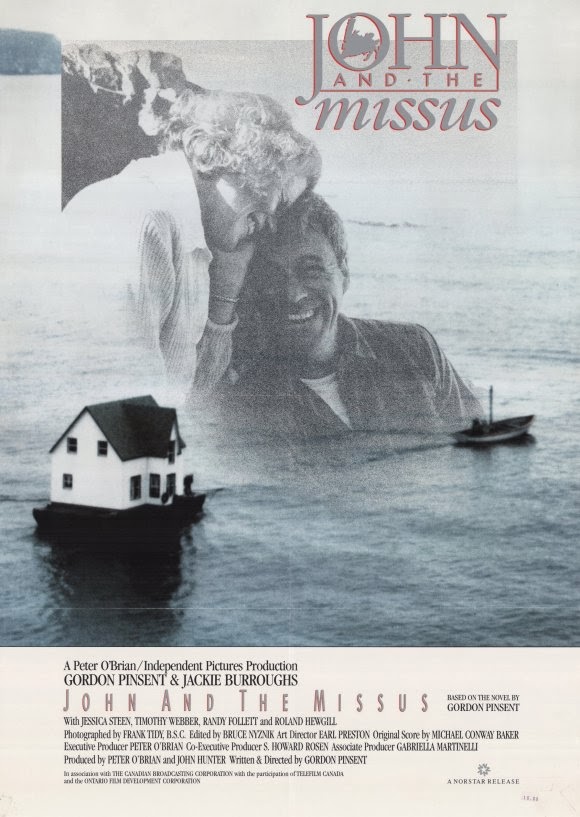
When a cave-in at the Cup Cove copper mine gives a government representative the opportunity to permanently close the mine – and, by extension, the town – John (Gordon Pinsent) fights back to save the mine and the town he loves. This struggle tests not only the deep love that John and the Missus (Jackie Burroughs) have for each other and their family, but John’s own sense of self. When resistance proves futile and everyone around him has given in, he literally uproots his house and sails away.
John and the Missus was clearly a labour of love for Gordon Pinsent, who directed and stars in the film and adapted the screenplay from his own novel. In many ways, it is a companion piece to Peter Carter’s The Rowdyman (1972). Also written by and starring Pinsent, The Rowdyman focuses on a young rabble-rouser who stirs up trouble in his Newfoundland village, while John and the Missus depicts the importance and sanctity of community to a more mature and wiser man. A sentimental look back to a time when small Newfoundland communities were a way of life to be treasured, the film was nominated for six Genie Awards and won for Leading Actor (Pinsent) and Music Score (Michael Conway-Baker).
From the Canadian Film Encyclopedia
Nov 27, 2013
The Silent Partner, Dec.10th Mayfair Theatre
The Silent
Partner, 1979, Directed by Daryl Duke, 106mins, 1.85, mono,
rated R, 35mm original print, Mayfair Theatre Dec. 10th 9:15pm
 Christopher Plummer gets to play big, bad, and bold as
the villain of The Silent Partner, a thriller set in late 1970's Toronto. Using the Eaton
Centre as a prime location, The Silent Partner also stars Elliot Gould as a bank clerk out to thwart
Plummer's plans. Great fun, and more than a little shocking at times for its
ferocious depiction of ruthless criminality. This film was written by Curtis
Hanson, who later went on to direct L.A. Confidential, The River Wild,Wonder Boys and 8 Mile. A highlight of the Tax Shelter Years, this film was one
of the more polished films of the era. Also starring Susannah Yorke. Watch for
an appearance by John Candy.
Christopher Plummer gets to play big, bad, and bold as
the villain of The Silent Partner, a thriller set in late 1970's Toronto. Using the Eaton
Centre as a prime location, The Silent Partner also stars Elliot Gould as a bank clerk out to thwart
Plummer's plans. Great fun, and more than a little shocking at times for its
ferocious depiction of ruthless criminality. This film was written by Curtis
Hanson, who later went on to direct L.A. Confidential, The River Wild,Wonder Boys and 8 Mile. A highlight of the Tax Shelter Years, this film was one
of the more polished films of the era. Also starring Susannah Yorke. Watch for
an appearance by John Candy.
 Christopher Plummer gets to play big, bad, and bold as
the villain of The Silent Partner, a thriller set in late 1970's Toronto. Using the Eaton
Centre as a prime location, The Silent Partner also stars Elliot Gould as a bank clerk out to thwart
Plummer's plans. Great fun, and more than a little shocking at times for its
ferocious depiction of ruthless criminality. This film was written by Curtis
Hanson, who later went on to direct L.A. Confidential, The River Wild,Wonder Boys and 8 Mile. A highlight of the Tax Shelter Years, this film was one
of the more polished films of the era. Also starring Susannah Yorke. Watch for
an appearance by John Candy.
Christopher Plummer gets to play big, bad, and bold as
the villain of The Silent Partner, a thriller set in late 1970's Toronto. Using the Eaton
Centre as a prime location, The Silent Partner also stars Elliot Gould as a bank clerk out to thwart
Plummer's plans. Great fun, and more than a little shocking at times for its
ferocious depiction of ruthless criminality. This film was written by Curtis
Hanson, who later went on to direct L.A. Confidential, The River Wild,Wonder Boys and 8 Mile. A highlight of the Tax Shelter Years, this film was one
of the more polished films of the era. Also starring Susannah Yorke. Watch for
an appearance by John Candy.
Subscribe to:
Posts (Atom)